
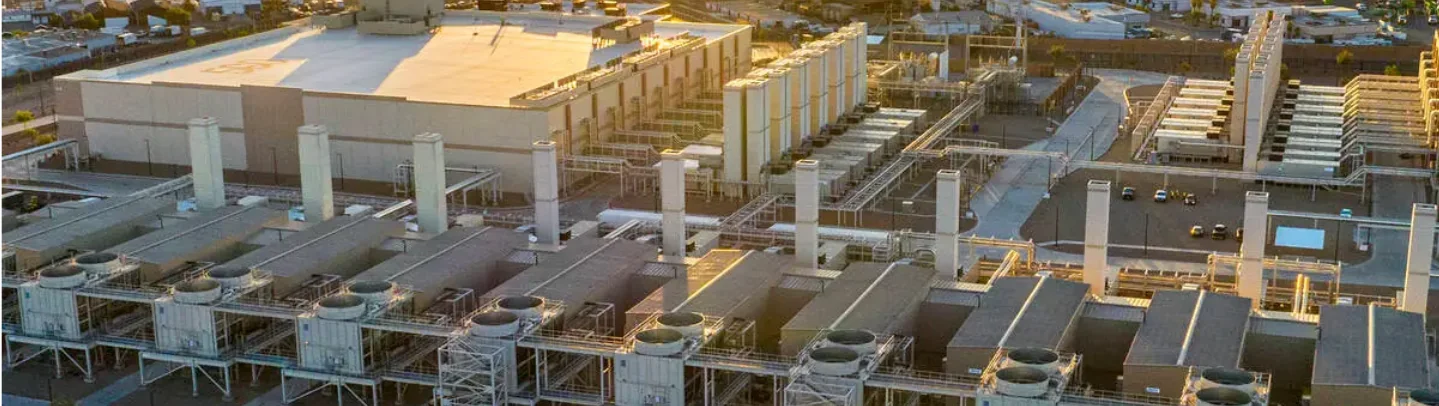

On September 1, 2026, the Interior Board of Land Appeals (IBLA) stayed a 300,000-square-foot data center project on federal lands near Boulder City, Nevada. This is the first time the federal government has stopped an approved data center project in its tracks.
IBLA is an adjudicatory body of administrative judges within the Department of the Interior. Opponents may appeal Bureau of Land Management (BLM) authorizations there instead of, or before, pursuing legal claims in federal court.
The local community of Boulder City, Nevada appealed BLM’s approval of the data center project, as did a coalition of environmental advocacy organizations. IBLA issued the stay about ten weeks after BLM approved the amended right-of-way. Boulder City, Nevada, Center for Biological Diversity, IBLA 2026-0213 & 2026-0216 (Sept. 1, 2026).
What Happened
Project infrastructure on federal lands requires a BLM right-of-way authorization. BLM analyzed a solar project on this site in a 2023 Environmental Assessment (EA) under the National Environmental Policy Act (NEPA). When the proponent sought to amend the right-of-way to authorize a data center, BLM did not prepare a new or revised EA. It issued a Determination of NEPA Adequacy (DNA), a checklist of prior analyses rather than an environmental analysis.
The BLM DNA concluded that the data center was substantially the same as the solar project. IBLA disagreed. A data center is not a solar facility in design, function, energy profile, or environmental impacts. IBLA found appellants likely to prevail on the merits of their legal claims and stayed the project pending resolution of the appeal.
Key Takeaways
- Process defeated this permit, not project design. IBLA did not question the project. It rejected the NEPA compliance shortcut. Pre-project planning and proactive permitting and litigation-risk strategies can protect the schedule.
- Thorough NEPA analysis protects the permit. Hire a third-party environmental contractor with extensive federal lands and NEPA experience. Analyze the project’s potential impacts in detail. Document the analysis and supporting data in the administrative record.
- Capital at risk will not defeat a stay. Economic harms did not move the needle on the balance of harm element of the stay standard. IBLA discounted capital exposure and carrying costs as temporary delay. Sponsors and lenders should price a 12-to-24-month appeal window into construction, offtake, tax equity, and interconnection milestones.
- Voluntary commitments mitigate environmental impacts, but they do not prove their absence. The proponent met data center industry best practices and Dark Sky standards. That record helped. It did not substitute for an environmental analysis of the data center itself under NEPA.
- Federal policy tailwinds did not control the outcome. IBLA weighed the national artificial intelligence infrastructure priority, then applied the same NEPA standard it applies to pipelines, transmission, and oil and gas facilities.
- Imprecision in the record creates a claim. BLM described a 12-month solar build and an 18-month data center build as both between “12 to 18 months.” IBLA said that framing masked a 50 percent increase in construction impacts. Precise numbers close off this legal vulnerability and attack.
- Early local government engagement is a critical diligence action, not an optics item. BLM never consulted Boulder City. The city became an appellant. Federal preemption of local zoning delivers no political cover and no litigation cover. A project proponent must engage the local community early and often, and press BLM to do the same, ideally jointly.
Looking Ahead
Interior’s February 2026 NEPA overhaul and new NEPA Handbook reset the framework. Several provisions favor project proponents. The new rules expand authority for applicant-prepared environmental documents and restore cooperating agency procedures.
Project proponents need a proactive strategy to engage the local community. Proponents that engage BLM early and build the record with counsel move faster, while also minimizing litigation and business risks.
Beatty & Wozniak, P.C. can help.
Please contact Bret Sumner or DeAnza Valencia for more information. This alert provides general information and does not constitute legal advice.